Number Sense for Preschoolers: A Parent's Guide
By Alyssa · Published
You might hear your preschooler count to ten, or even twenty, and feel a little burst of pride. That counting is a real accomplishment. But ask the same child to hand you five blocks, and you may get a handful of seven, or a confident, “Here's five!” with three.
That gap is where number sense lives. It is the difference between saying number words and understanding what numbers mean. The good news is that number sense grows through ordinary moments at home: sorting laundry, setting the table, counting stairs. You do not need flashcards or a curriculum. You need a few good questions and some curiosity.
This guide explains what number sense is, the building blocks to look for in children ages 3–6, and simple ways to explore numbers together.
What is number sense?
Number sense is a child's feel for numbers: what they mean, how big they are, and how they relate to each other. A child with growing number sense understands that:
- the number word “three” matches a quantity of three things
- four is more than three, and it is one more
- five can be made from two and three, or four and one
- a group of three looks like three whether the objects are close together, spread apart, or in a line
In 10 years of teaching middle and high school math, I saw how often older students struggled when these early ideas had never fully clicked. Fractions, algebra, and mental math all rest on a strong sense of how numbers work. Those foundations start in the preschool years, and they start with play.
Number sense vs. counting
Counting is an important part of number sense, but they are not the same thing.
Rote counting is saying the number words in order, like reciting the alphabet. Many children can count to ten before they understand what “ten” means.
Meaningful counting connects those words to real objects. When a child counts four apples, touches each apple once, and then says, “There are four!”, they are showing number sense.
So if your child can recite numbers but struggles with “How many?”, that is completely normal. It simply shows you the next step to explore.
The five building blocks of number sense
Here are the big ideas that make up early number sense, with what each one can look like at home.
1. Counting with meaning
Children learn to say one number word for each object, keep the words in the right order, and understand that the last number they say tells how many are in the group.
What it can look like: Your child counts four cars, then answers “How many cars?” with “Four!” without counting again.
2. Recognizing small groups at a glance (subitizing)
Subitizing is knowing how many are in a small group without counting each one. Think of how you instantly know a die shows five.
What it can look like: Your child sees three crackers on a plate and says “three” right away.
3. Comparing amounts
Children learn to notice which group has more, fewer, or the same, and eventually how many more.
What it can look like: “I have more grapes than you!” Then, with some practice: “I have two more!”
4. Making and breaking numbers apart
Numbers can be built from smaller parts. Five can be four and one, three and two, or five and zero. Mathematicians call this composing and decomposing. It is the root of addition and subtraction later on.
What it can look like: Your child puts five toy animals into two barns and notices, “Three here and two here. Still five!”
5. Showing a number in different ways
A number can be shown with objects, fingers, a drawing, dots, a ten frame, a spoken word, or a written numeral. Connecting these different representations deepens a child's understanding.
What it can look like: Your child holds up three fingers, draws three circles, and points to the numeral 3.
Simple ways to build number sense at home
You do not need to set aside special “math time.” Weave these into the moments you already share.
Count things that matter to your child
Count the stairs on the way up to bed, the strawberries on their plate, or the buttons on their coat. Touch or point to each item as you count together, then ask, “So how many are there?” That last question helps connect counting to quantity.
Play “quick look”
Put a small group of objects (two to five) on the table, let your child peek for a moment, then cover them. Ask, “How many did you see?” Then, “How did you know?” You may hear something like, “I saw two and two.” That is subitizing and number sense at work.
Ask “more or fewer?” at snack time
Make two small piles of snacks and ask which has more. Then try, “How could we make them the same?” Let your child move pieces around to find out.
Find a pair, then find two another way
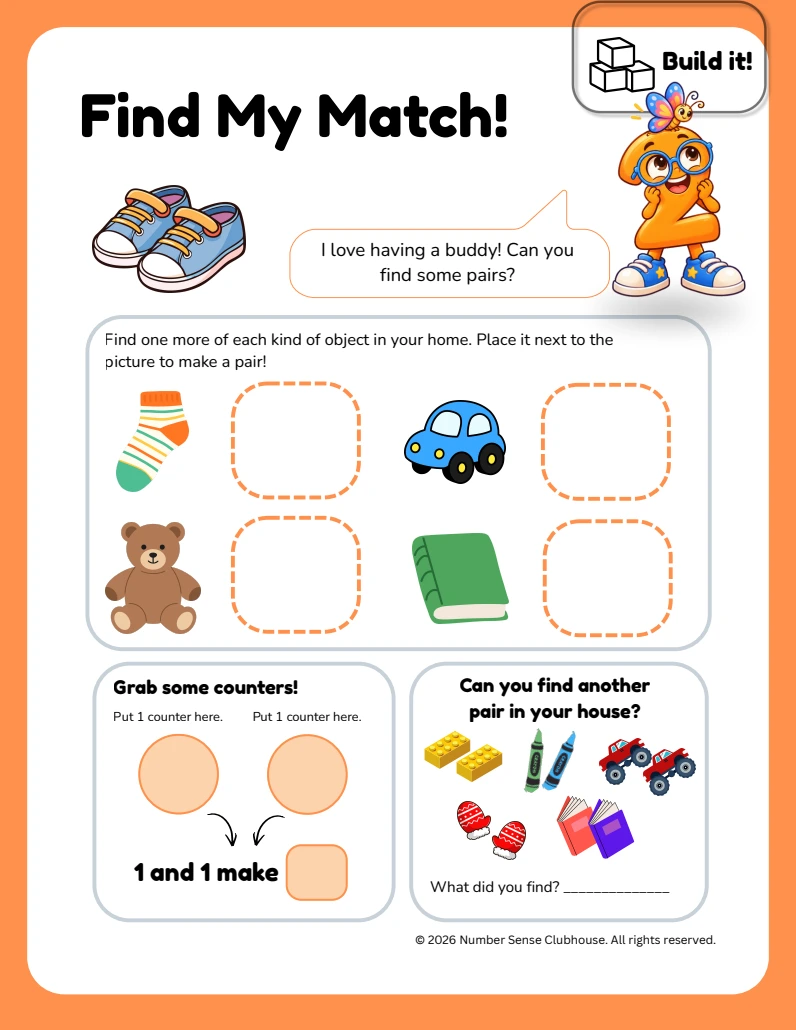
Here is a favorite: put one sock on the floor and ask your child to find its match. Count the pair together: “One, two. We have two socks!” Move the socks apart and ask, “Do we still have two?” Then look for other pairs around the house: two shoes, two spoons, two cushions. It is a simple way to explore what “two” really means.
Use fingers freely
Fingers are a built-in math tool that children carry everywhere. Ask your child to show you four on their fingers, then four a different way. Many children are delighted to discover that three fingers on one hand and one on the other is still four.
Build a number with toys
Choose a number, like five, and invite your child to make it with blocks, toy cars, or stuffed animals. Then ask, “Can you split them into two groups? What groups did you make?” Write down or draw the different ways you find together.
Read and notice numbers together
Picture books, house numbers, clocks, and price tags are full of numerals. Point them out, and connect the written number to a quantity: “That sign says 3. Can you show me three jumps?”
Questions that spark number talk
The questions you ask matter more than the activity itself. Try a few of these:
- What do you notice?
- How many do you think there are? How could we check?
- How did you figure that out?
- Which group has more? How do you know?
- Can you show me that number another way?
- What would happen if we added one more? Took one away?
You do not need to ask them all. Pick one, listen closely to your child's answer, and follow their thinking. Sometimes their explanation is more interesting than the right answer.
Tips for keeping it playful
Keep it short. A few minutes of number play is plenty for a preschooler. Stop while it is still fun.
Follow your child's lead. If they would rather line up the cars than count them, that is okay. Sorting and arranging are math too. Join in and add a question when the moment feels right.
Celebrate thinking, not just answers. “I love how you checked by counting again!” teaches your child that math is about figuring things out.
Make mistakes safe. If your child says there are six when there are five, try, “Let's count together and see.” There is no need to rush to correct them.
Start small. Numbers 1 to 5 offer plenty to explore. When those feel comfortable, move toward 10.
Revisit often. Children build understanding by seeing the same idea many times in many ways. Counting stairs every night is not repetitive to a preschooler. It is practice.
Every child grows at their own pace
Some children recognize small groups early but are still sorting out counting. Others count confidently but are just beginning to compare amounts. Number sense does not develop in a straight line, and there is no single “right” age for each skill. What matters most is that your child has regular, low-pressure chances to notice, count, talk about, and play with numbers.
If you ever have questions about your child's development, your child's teacher or pediatrician is a great person to talk with.
Where to start this week
Pick one idea from this guide and try it a few times this week. Count something at dinner. Play quick look with a handful of cereal. Hunt for pairs on laundry day. Small, playful moments add up.
If you would like ready-to-use activities, the free Number Friends coloring pages for numbers 1–5 are a gentle way to meet the characters and start talking about numbers. For a fuller exploration of each number from 0 to 10, take a look at the Numbers 1–10 Activity Bundle.
Questions about this activity
At what age should my child start learning number sense?
Number sense starts long before formal math. Toddlers already notice “more” and “all gone.” Between ages 3 and 6, most children are ready for playful counting, comparing, and noticing small groups. Every child moves at their own pace, so follow your child's interest rather than a timeline.
My child can count to 20. Do they have number sense?
Reciting numbers in order is a wonderful start, and it is only one piece. Number sense means understanding what those numbers mean: that five crackers is a quantity, that five is one more than four, and that five can be made from three and two. Try asking “How many?” after counting a group to see how your child connects the words to an amount.
Do I need special materials to teach number sense?
No. Socks, snacks, toy cars, stairs, and fingers all work. Printables can add structure and give you ideas to try, but everyday objects and a few good questions do most of the work.
How long should a number sense activity take?
For preschoolers, a few minutes is plenty. Short, frequent moments of number talk, like counting stairs or comparing two piles of blocks, tend to be more enjoyable than one long session. Stop while it is still fun.
What if my child gets an answer wrong?
Stay curious instead of correcting right away. Ask, “How did you figure that out?” or “Let's count together and check.” Explaining their thinking is part of building number sense, and mistakes often show you exactly what your child is working on.