Christmas Counting Activities for Preschoolers (Ages 3–6)
By Alyssa · Published
The weeks before Christmas are full of things to count: days until Santa arrives, ornaments on the tree, cookies cooling on the counter, presents piling up underneath. For a preschooler, that excitement is the perfect reason to explore numbers.
These Christmas counting activities for preschoolers use what you already have around the house. No worksheets or special supplies needed. Each holiday math game takes just a few minutes and helps build number sense: understanding what numbers mean, not just saying them in order. They work for children ages 3–6, at home, in a homeschool, or in a preschool or kindergarten classroom.
Why holiday math works so well for young children
Young children learn math best when it has a purpose. Counting cookies is more exciting than counting dots on a page, especially when there is a chance to eat one afterward.
Holiday activities also give you many small, natural moments to talk about numbers. When your child counts presents, compares stockings, or shares candy canes, they are practicing early math skills like:
- counting with meaning: matching one number word to each object
- comparing: noticing more, fewer, or the same
- making ten: discovering the pairs of numbers that add up to 10
- early addition and subtraction: one more, one less, putting together, taking away
- equal sharing: dividing a group fairly
If you are new to the idea of number sense, our parent's guide to number sense for preschoolers explains the building blocks in more detail.
10 easy Christmas counting activities for preschoolers
1. Count the Christmas countdown
Turn your advent calendar or paper chain into a daily Christmas countdown math moment. Each morning, count how many days are left together. Then ask, “Yesterday we had 9. Today we have 8. What happened?”
Skills: counting backward, one less
Make it easier: Count only the last 5 days. Make it harder: Ask, “How many days have already gone by?”
2. Decorate a felt or paper tree
Cut a simple tree from green paper or felt. Roll a die, then add that many paper “ornaments,” buttons, or pom-poms. Count them together and ask, “How many ornaments are on the tree now?”
Skills: one-to-one counting, recognizing dot patterns on a die
Make it easier: Use a die with only 1–3 dots, or simply hold up fingers. Make it harder: Roll twice and add the ornaments together.
3. Make an egg-carton ten frame
A ten frame is a simple grid of ten boxes that helps children see numbers in groups of five and ten. Cut an egg carton down to two rows of five, and you have a Christmas ten frame. Fill it with jingle bells, red and green pom-poms, or small ornaments.
Ask, “How many are filled? How many empty spaces are left? How many more do we need to make ten?”
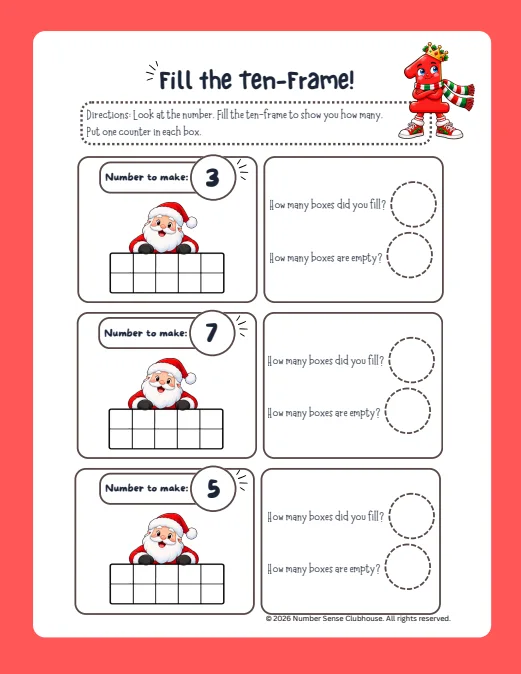
Skills: counting to 10, making ten, seeing 5 as a landmark
4. Cookies on two plates
When you bake or buy Christmas cookies, set out two plates. Place 4 cookies on one plate and 6 on the other. Ask, “How many cookies are there altogether?” Count to find out, then try other pairs that make 10, like 7 and 3 or 8 and 2.
This is the same idea behind Cookies at the Clubhouse, the first mission in our Christmas math activities bundle.
Skills: addition, making ten, number pairs
5. Share the presents fairly
Wrap small empty boxes (or use blocks) as “presents.” Set out two stuffed animals and ask your child to share 6 presents fairly between them. Did each one get the same amount? How do you know?
Skills: equal sharing, comparing, early division
Make it harder: Try sharing 10 presents. Then try 7. What happens when there is one left over?
6. Candy cane more or fewer
Make two small piles of candy canes, mini marshmallows, or holiday crackers. Ask, “Which pile has more? How could you check?” Let your child line the items up side by side to compare.
Skills: comparing quantities, more and fewer
7. Jingle bell quick look
Hide a small number of jingle bells (two to five) under a cup. Lift the cup for a quick peek, then cover it again. Ask, “How many did you see? How did you know so fast?”
Recognizing a small amount at a glance, without counting each one, is called subitizing. It is an important early math skill, and children often love this quick, game-like challenge.
Skills: subitizing, visual number sense
8. Stocking story problems
Hang two stockings (or use two socks). Tell a little story: “Santa put 3 candies in this stocking and 2 in that one. How many candies did he leave?” Let your child act it out with real objects.
Then try a take-away story: “There were 5 candies. The elf ate 1! How many are left?”
Skills: addition and subtraction stories, problem solving
9. Wrapping paper pattern hunt
Look closely at your wrapping paper together. Can your child find a pattern, like tree, star, tree, star? Count how many trees appear in one row. Then invite your child to make their own pattern with stickers or stamps.
Skills: patterns, counting, noticing structure
10. Rearrange the ornaments
Put 10 ornaments (or pom-poms) in a row and count them together. Then spread them out, bunch them up, or arrange them in a circle. Ask, “Do we still have 10? Did we add any or take any away?”
Children are often surprised that the amount stays the same when the arrangement changes. This is a big idea in early math, and a fun one to discover.
Skills: conservation of number, counting, explaining thinking
Questions to ask during holiday math play
The right question turns a simple activity into real math thinking. Try one of these during any of the games above:
- How many do you think there are? How could we check?
- How did you figure that out?
- Which group has more? How do you know?
- How many more do we need to make ten?
- What would happen if Santa added one more?
- Can you show me that number another way?
Listen to your child's answer and follow their thinking. Their explanation is often just as valuable as the answer itself.
Tips for stress-free Christmas math at home
Keep it short and sweet. Five to ten minutes is plenty, especially during a busy holiday season.
Use real objects. Hands-on counting with ornaments, cookies, and bells helps young children connect numbers to real amounts.
Start with small numbers. Groups up to 5 are perfect for younger preschoolers. Move toward 10 as your child gains confidence.
Repeat favorites. Playing the same game several times is not boring to a preschooler. It is how understanding grows.
Celebrate the thinking. Praise how your child figured something out, not just whether they got the right answer.
Stay safe. Choose ornaments and small objects that are appropriate for your child's age, and supervise closely around small items.
Ready for a Christmas math adventure?
If your child loves these holiday counting games, the Christmas Mission Activity Bundle turns them into a story. Your child joins the Number Friends to help Santa get ready for Christmas Eve across five math missions:
- Cookies at the Clubhouse! Make ten with 4 and 6.
- The Journey to the North Pole! Combine 1 and 9 to paint stepping stones.
- Toy Trouble at Santa's Workshop! Help 8 and 2 fill Santa's sack.
- Santa's Sleigh Lift-Off! Fill a ten-space Christmas Cheer Barometer with 7 and 3.
- Present Delivery! Share ten presents fairly between two houses.
Each mission includes a bonus challenge for children ready for more. It is a printable PDF you can download instantly and print at home or in your classroom.
Explore the Christmas math activities →
New to the Number Friends? Meet them first with our free number coloring pages for numbers 1–5.
Questions about this activity
What are good Christmas math activities for preschoolers?
The best holiday math activities for preschoolers are short, hands-on, and use real objects. Try counting ornaments onto a tree, filling an egg-carton ten frame with pom-poms, or sharing cookies fairly between two plates. Each one gives your child a reason to count, compare, and talk about numbers.
How do I make a Christmas countdown into a counting activity?
Each morning, ask your child how many days are left, then count them together on the calendar or paper chain. Ask, “Yesterday there were 8. Today there are 7. What changed?” This turns the countdown into a daily lesson in counting backward and “one less.”
What materials do I need for these holiday counting games?
Most of these activities use things already in your home during the holidays: ornaments, jingle bells, wrapping paper, cookie cutters, small gift boxes, and an empty egg carton. Choose objects that are safe and age-appropriate for your child, and stay close by during play.
Are these Christmas activities for preschool or kindergarten?
Both. The activities are written for ages 3–6. Younger children can count small groups up to 5, while kindergarteners can work up to 10, explore making ten, or try simple addition and subtraction stories.
How long should a holiday math activity take?
Five to ten minutes is plenty for most preschoolers. The holidays are busy and exciting, so short, playful moments of math work better than long sessions. Stop while your child is still having fun.
Related guides
Number Sense for Preschoolers: A Parent's Guide
What number sense means for ages 3–6, the five building blocks to look for, and simple everyday ways to explore numbers with your preschooler at home.