My Child Can Count, but Gets Stuck on What Number Comes Next
By Alyssa King · Published
Your child can count to ten, but when you ask, “What comes after seven?” they’re not sure where to start. Try counting into the number together: “Six, seven …” Then pause. If your child needs to start at one, let them. Next, use a toy on a short numbered path so they can see where to go instead of having to answer from memory.
Why is this harder than counting to ten?
Saying the numbers from one and jumping into the count at seven are different skills. A child who says “eight” after counting from one has found the right answer and used a strategy to get there. You can give them a shorter starting point over time: “Five, six, seven …” and then “Six, seven …”
The Institute of Education Sciences calls identifying the next number without always counting from one number-after knowledge. Its Teaching Math to Young Children practice guide also describes a related idea: each next number represents exactly one more. A toy car helps with the first idea. A handful of blocks helps with the second.
Try it: Drive to the next number
You’ll need: a piece of paper, a marker and a toy car or other small toy your child already plays with safely.
- Draw six parking spaces in a row. Label them 1 to 6. Point to each space and say its number together.
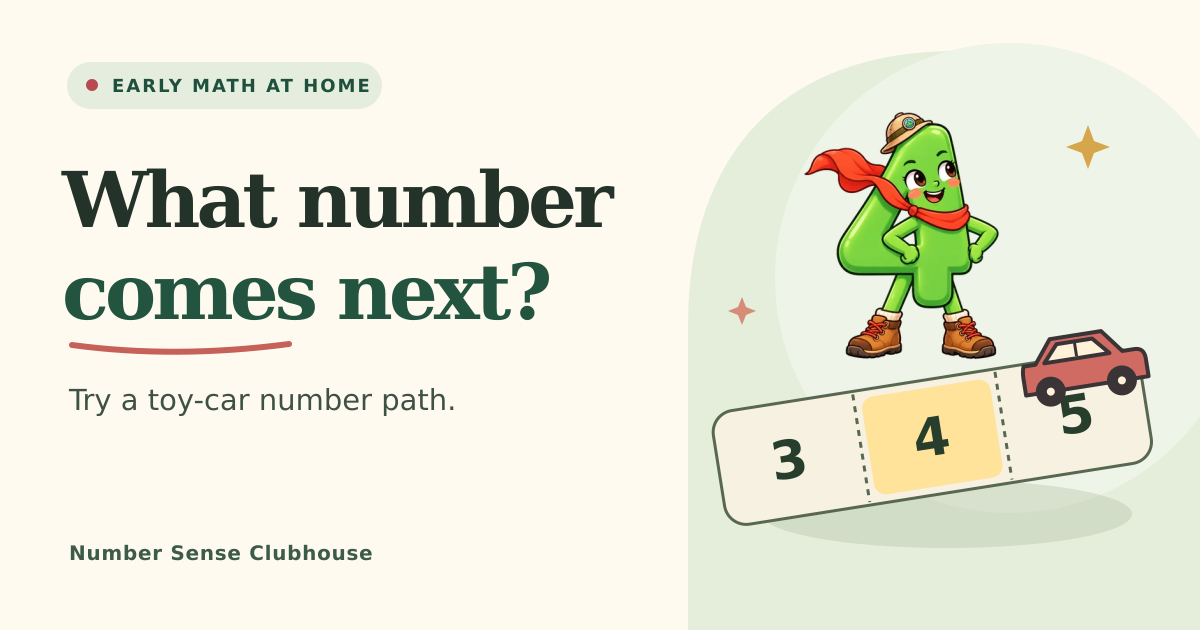
- Park on 4. Say, “We’re parked on four. Can you drive one space this way?” Point toward 5. Move the car one space and say, “We landed on five. Five comes right after four.”
- Let your child drive. Park on 2 and say, “We’re on two. What number will we land on if we go one space?” If they’re unsure, point and count with them or say, “One, two …” and leave room for “three.”
- Switch roles. Let your child choose a starting spot with another space ahead and ask you what comes next. Give yourself a count-in so they see that grown-ups use strategies, too.
Keep the numbers visible. If your child doesn’t recognize a written number, you can name it for them. If that’s the part they want to practice, try these number recognition games another time. Pointing to the next space is a way to play even when they aren’t ready to say its name.
Now show what “one more” means
Park the car and set out four blocks. Count them together and say, “We have four blocks.” Let your child put one more block beside them without moving the others. Ask, “How many are there now?” Count all five if that helps. Then say, “Five comes right after four. We added one block, so now there are five.”
You can do the same thing at snack time: set out two crackers, add one, and ask what changed. The goal is to notice what the next number means, not to get the answer faster.
A couple of questions parents ask
What if my child guesses a number?
Show them how to check: “Let’s drive one space and see where we land.” If “after” is the confusing part, use “next” and point in the direction the car will go. Then connect the words: “Three is next. It comes right after two.”
Should I practice “what comes before” at the same time?
Try “after” on its own first so the direction stays clear. When your child is comfortable, play a short reverse round. Put the car on 4, move back to 3, and say, “Three comes right before four.” There’s no need to count all the way backward.
If your child wants another round, line up a few of our free printable Number Friends cards as your next road. Let them pick the first parking spot.