Math Talk for Preschoolers: Easy Ways to Talk About Numbers
By Alyssa King · Published
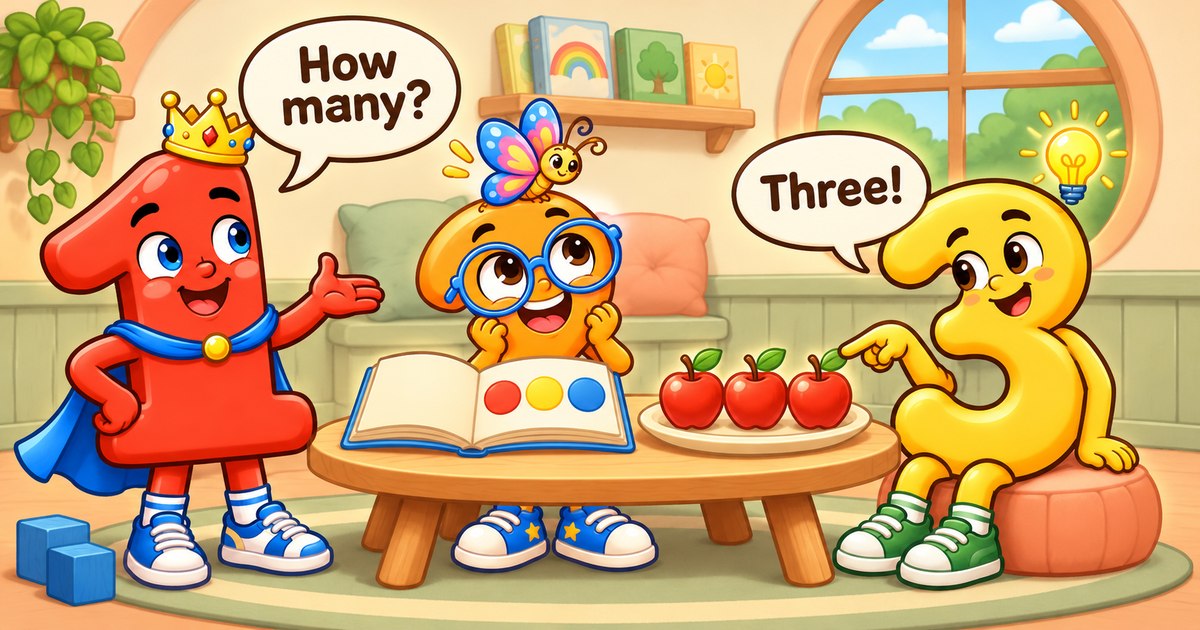
You may not think of yourself as a math teacher. But every time you count stairs with your child, ask which cookie is bigger, or say, “Let's grab three apples,” you are teaching math.
Educators call this math talk: everyday conversation about numbers, amounts, and shapes. A growing body of research suggests that how parents talk about numbers at home can make a real difference in young children's math understanding. The best part is that it costs nothing and fits into moments you already share.
This guide covers what research says about math talk for preschoolers, and gives you simple phrases, questions, and book tips to use starting today.
Why early math matters
Early math skills are more than a head start on counting. In a large analysis of six long-term studies, researchers led by Greg Duncan found that children's math skills when they started school were the strongest predictor of later school achievement among the school-entry skills they measured. Early math predicted later reading achievement as well as later math.1
That study shows a connection, not proof that early math causes later success. Still, it is one reason educators encourage families to make numbers part of everyday life during the preschool years.
What research says about math talk at home
The amount of number talk varies, and it matters
Researchers at the University of Chicago recorded everyday conversations between parents and toddlers at home, from about 14 to 30 months old. They found big differences in how much parents talked about numbers. Children who heard more number talk, especially counting or labeling sets of objects they could see, later had a better understanding of what number words mean.2
Two details stood out:
- Talk about objects in front of the child mattered most. Saying “Look, four ducks! One, two, three, four” was more helpful than saying numbers with nothing to count.
- Talk about larger groups was especially helpful. In that study, counting or naming groups of four to ten objects predicted later number knowledge more strongly than talk about very small groups.
Math talk through books can boost number knowledge
That first study observed families. It could not show that number talk causes better number knowledge. So a later study tested it directly.
In a 2020 experiment, 100 children ages 2 to 4 and their parents were randomly assigned to read one of three types of picture books every day for four weeks: books about small numbers (1–3), books about larger numbers (4–6), or books without number content. Children whose parents read the number books improved in number knowledge compared with children in the non-number group. The small-number books were especially effective overall, and children who were already further along also benefited from the larger-number books.3
What this means for your family
Put together, these studies point to a simple idea: talk about numbers often, connect them to real things your child can see, and match the size of the numbers to your child's level. Begin with small groups, and count larger groups as your child grows more confident.
10 everyday ways to add math talk to your day
1. Count what you see
Count stairs, shoes by the door, or ducks at the pond. Point to each one as you count, then say the total: “One, two, three, four. Four ducks!”
2. Ask “How many?”
After counting, ask, “How many are there?” This helps your child connect the last number to the size of the group.
3. Compare with “more” and “fewer”
At snack time, ask, “Who has more crackers? How do you know?” Line up the crackers side by side to check.
4. Use numbers in requests
Instead of “Grab some spoons,” try “Can you bring me three spoons?” Your child has to count out the right amount and stop.
5. Talk about one more and one less
“You have four blocks. If I give you one more, how many will you have?” Then try one less.
6. Notice numbers in the world
Point out house numbers, prices, page numbers, and clocks. Connect them to amounts: “That sign says 5. Can you show me 5 fingers?”
7. Describe size and shape
Use words like bigger, smaller, longer, shorter, taller, round, and square. Measurement and shape words are math talk too.
8. Read counting books and count the pictures
Pause on each page to count the pictures together and ask “how many” questions. Number-focused books are an easy way to add math talk to a bedtime routine.
9. Count during play
Count blocks as you build a tower, cars as you line them up, or jumps on the trampoline. Board games give natural chances to count too. See math board games for preschoolers for research-backed game ideas.
10. Ask your child to explain
“How did you figure that out?” is one of the most powerful questions in early math. It shows your child that their thinking matters.
Math talk phrases to try
Keep a few of these ready:
- “Let's count them together.”
- “How many do you think there are? Let's check.”
- “Which group has more? Which has fewer?”
- “What if we added one more?”
- “Can you show me that number another way?”
- “How did you know?”
- “Is that more than five or less than five?”
- “Do we have enough for everyone?”
Tips for natural, stress-free math talk
Keep it conversational. Math talk works best as part of everyday chatting, not as a quiz.
Connect numbers to real things. Counting objects your child can see and touch is more meaningful than reciting numbers.
Follow your child's interests. Count dinosaurs, trucks, or stickers, whatever they love.
Celebrate thinking. Praise how your child figured something out, not just whether the answer was right.
Little and often. A few moments of math talk spread throughout the day add up.
To understand the bigger picture, read our parent's guide to number sense for preschoolers.
Start talking numbers today
Pick one moment today, like snack time, the stairs, or bedtime stories, and add a little math talk. Count together, ask “how many,” and listen to your child's thinking.
The Numbers 1–10 Activity Bundle invites children to notice, count, and show their ideas, giving you plenty of natural moments for math talk. To start for free, try our Number Friends coloring pages for numbers 1–5.
References
- Duncan, G. J., Dowsett, C. J., Claessens, A., et al. (2007). School readiness and later achievement. Developmental Psychology, 43(6), 1428–1446. https://doi.org/10.1037/0012-1649.43.6.1428
- Gunderson, E. A., & Levine, S. C. (2011). Some types of parent number talk count more than others: Relations between parents' input and children's cardinal-number knowledge. Developmental Science, 14(5), 1021–1032. https://doi.org/10.1111/j.1467-7687.2011.01050.x
- Gibson, D. J., Gunderson, E. A., & Levine, S. C. (2020). Causal effects of parent number talk on preschoolers' number knowledge. Child Development, 91(6), e1162–e1177. https://doi.org/10.1111/cdev.13423
Common questions
What is math talk?
Math talk is everyday conversation about numbers, amounts, shapes, and patterns. Counting the apples in a bowl, asking “Which plate has more?”, or noticing that three blocks plus one more makes four are all examples of math talk.
Does talking about numbers really help young children?
Research suggests it can. Studies at the University of Chicago found that toddlers whose parents talked more about numbers, especially while counting or naming sets of objects in front of them, later understood number words better. A 2020 experiment found that reading number-focused picture books with parents every day for four weeks improved 2- to 4-year-olds' number knowledge.
How can I add math talk to my day?
Count real things during routines: stairs, snacks, toys at clean-up. Then ask “How many?” and “Which has more?” Point out numbers on signs and pages, and read counting books together, pausing to count the pictures.
What age should I start talking about numbers with my child?
You can start in the toddler years. The research described here followed children from as young as 14 months, and the book study included 2- to 4-year-olds. Math talk continues to help through preschool and kindergarten.
Should I use big numbers or small numbers?
Match your child's level. For children just beginning, talking about small groups of one to three works well. As children grow more confident, counting larger groups of four to ten objects together offers more of a challenge.
Related guides
Number Sense for Preschoolers: A Parent's Guide
What number sense means for ages 3–6, the five building blocks to look for, and simple everyday ways to explore numbers with your preschooler at home.
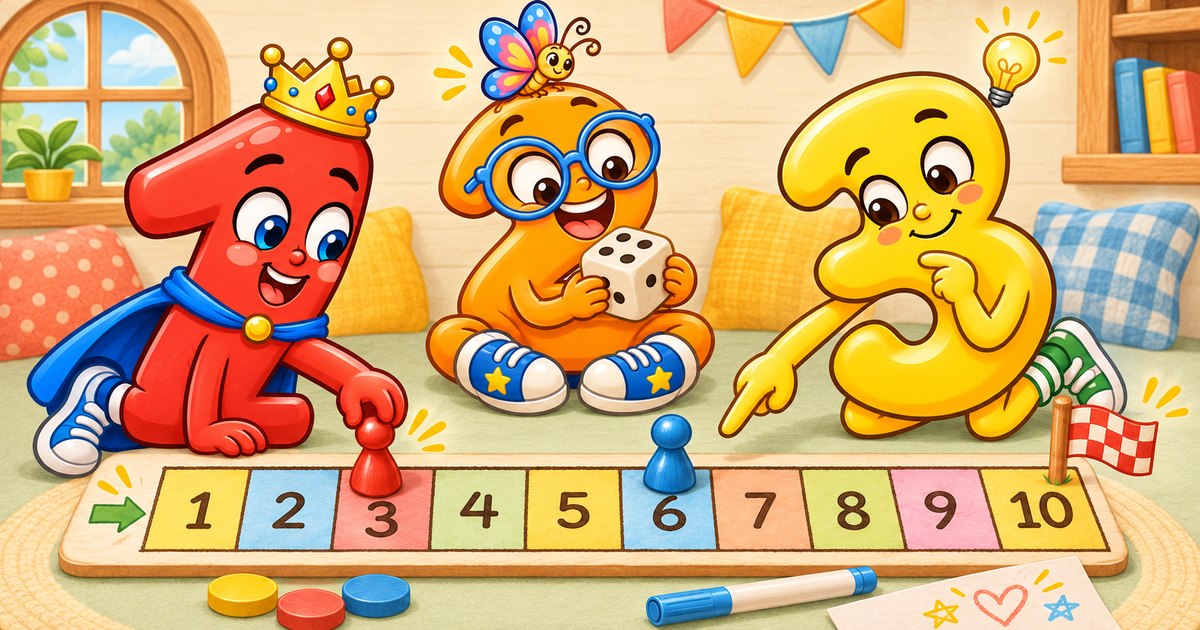
Math Board Games for Preschoolers: What Research Shows
Why simple number board games build preschool math skills, what a well-known study found, and how to make your own 1–10 race game at home in minutes.