Math Board Games for Preschoolers: What Research Shows
By Alyssa King · Published
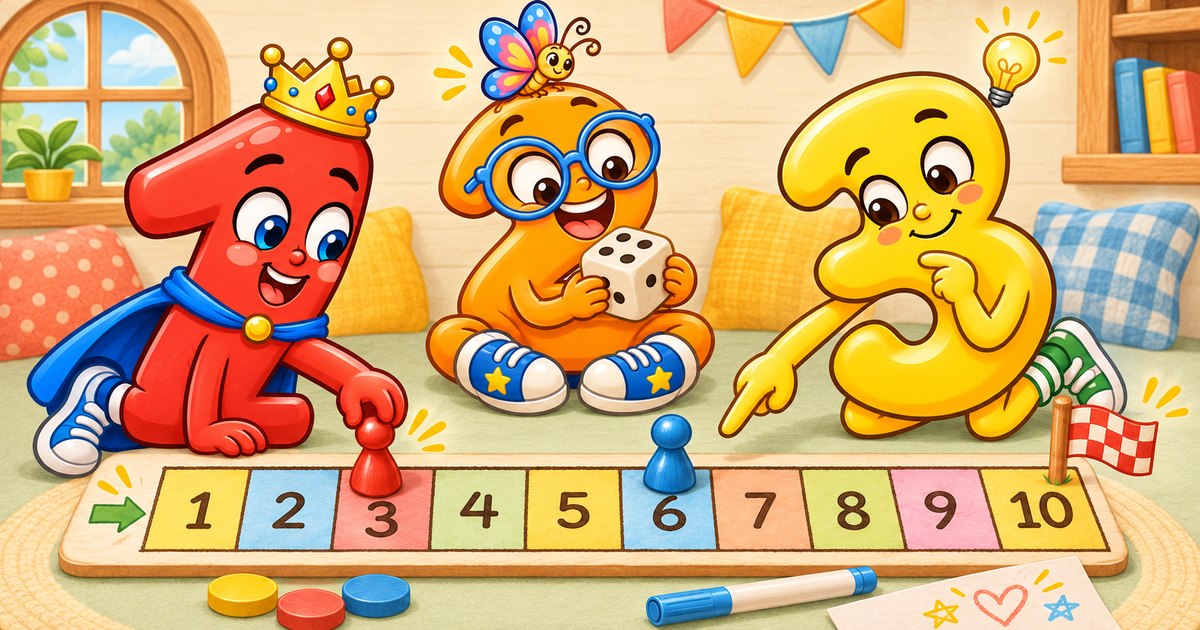
Family game night may be one of the easiest ways to build your child's math skills, no worksheets required. When a preschooler rolls a die, counts the dots, and moves their piece along a numbered path, they are practicing counting, number recognition, and the idea that bigger numbers are farther along.
And this is not just a hunch. A well-known study published in the journal Child Development found that a simple number board game led to real improvements in preschoolers' number knowledge.
This guide explains what the research says about math board games for preschoolers, what makes a game good for early math, and how to make your own number board game at home in just a few minutes.
What the research says about board games and early math
In a 2008 study, psychologists Geetha Ramani and Robert Siegler worked with preschool children attending Head Start programs, which serve families with lower incomes. Children were randomly assigned to play one of two versions of a simple board game with an adult:
- The number game had a straight path of spaces marked with numbers.
- The comparison game looked similar, but its spaces were marked with colors instead of numbers.
Children played for roughly an hour in total, spread across about two weeks.
The researchers found that children who played the number game improved in four areas:
- Counting
- Identifying printed numerals
- Comparing numbers to tell which one is bigger
- Estimating where numbers go on a number line
Children who played the color version did not show the same gains. And when the researchers checked again nine weeks later, the number-game children had kept their improvements.
The researchers suggest the straight, numbered path is part of why it works. As a child moves farther along, the numbers get bigger, so the game shows children what “bigger” means in a way they can see and feel.
Source: Ramani, G. B., & Siegler, R. S. (2008). Promoting broad and stable improvements in low-income children's numerical knowledge through playing number board games. Child Development, 79(2), 375–394. doi.org/10.1111/j.1467-8624.2007.01131.x
What this means for your family
One study can't promise results for every child, and this one focused on specific skills with a specific group of children. Still, the takeaway for parents is encouraging: short, playful number games with a grown-up can make a meaningful difference. And they cost almost nothing.
What makes a board game good for preschool math?
Not every game builds number skills equally. Look for these features:
- A straight path of numbered spaces. Numbers that increase in a line make the size of each number easy to see.
- Small numbers to move. A die, spinner, or cards with 1, 2, or 3 keep counting manageable.
- Moving one space at a time. Each hop matches one number word.
- Saying numbers out loud. Naming each space as you land on it (“seven, eight!”) connects the word, the numeral, and the distance.
- Short games. Five to ten minutes keeps young children engaged.
Many classic race-to-the-finish games for young children share these features. You can also make one yourself.
How to make a DIY number board game (1–10)
What you need
- A sheet of paper and a marker
- Two small toys or buttons to use as game pieces
- A coin, or a paper spinner divided into two halves labeled 1 and 2
Choose game pieces that are safe for your child's age, and supervise closely around small objects.
How to make it
- Draw a straight row of 10 large squares across the paper.
- Write the numbers 1 to 10 in the squares, from left to right.
- Draw a “Start” box before 1 and a star or finish line after 10.
- Make your spinner, or use a coin: heads moves 1, tails moves 2.
How to play
- Each player places a piece on Start.
- Take turns spinning or flipping, then move that many spaces.
- Say the number of each space as you move: “I'm on 3. I spun 2, so four, five!” Encourage your child to do the same.
- The first player to reach 10 wins. Then play again.
Make it easier: Use a path of 5 squares, and move only 1 space per turn. Make it harder: Stretch the path to 20 squares, or use a standard die.
6 more math games for preschoolers
1. Race to 10 with a ten frame
Draw two rows of five boxes. Take turns rolling a die and adding that many counters. The first person to fill the frame wins. Learn more in our guide to ten frames for preschoolers.
2. Dice match
Roll two dice and ask, “Which one has more?” Children quickly start recognizing dot patterns without counting, a skill called subitizing. Our guide What Is Subitizing? has more games to try.
3. Number card war
Use playing cards from ace to 5 (or 10 for older children). Each player flips a card, and the bigger number wins both cards. Ask, “How do you know your number is bigger?”
4. Number memory
Lay out pairs of number cards face down and take turns finding matches. Say each number as you flip it.
5. Roll and count
Roll a die and do that many claps, jumps, or toe touches. Count together as you move.
6. Hide and find numbers
Hide paper numbers 1 to 10 around a room. As your child finds each one, place it on a number line taped to the floor, in order.
Tips for playing math games with preschoolers
Play together. The adult's role matters. Count with your child, name the numbers, and ask questions.
Say the numbers out loud. Naming each space as you move connects number words to positions on the path.
Keep it short and happy. End the game while your child still wants to play again.
Let them win sometimes. A little success keeps young children motivated.
Ask “how do you know?” Questions like “How did you know you were ahead?” turn a game into a math conversation.
Repeat favorite games. Playing the same simple game many times is how skills become solid.
Bring numbers to game night
Draw a 1–10 game path tonight and play a few quick rounds. It takes five minutes to make, and it gives your child a fun, repeatable way to practice numbers.
For more ways to explore each number, the Numbers 1–10 Activity Bundle gives your child pages to meet, see, show, and build every number from 0 to 10. To start for free, try our Number Friends coloring pages for numbers 1–5.
Reference
Ramani, G. B., & Siegler, R. S. (2008). Promoting broad and stable improvements in low-income children's numerical knowledge through playing number board games. Child Development, 79(2), 375–394. https://doi.org/10.1111/j.1467-8624.2007.01131.x
Common questions
Do board games really help preschoolers learn math?
Research suggests they can. In a randomized study published in Child Development (Ramani & Siegler, 2008), preschoolers in Head Start programs who played a simple numbered board game for about an hour in total, spread over two weeks, improved in counting, identifying numerals, comparing numbers, and placing numbers on a number line. Children who played the same kind of game with colors instead of numbers did not show those gains.
What makes a board game good for preschool math?
Look for a game with a straight path of numbered spaces, a die or spinner with small numbers, and moves that go forward one space at a time. Saying the numbers out loud while moving helps children connect number words, numerals, and distance along the path.
What age can children start playing number board games?
Many children can enjoy a simple race game with a short numbered path around ages 3 to 4, with a grown-up playing alongside. Start with a path of 10 spaces and a die or spinner showing 1 and 2, then make the game longer as your child grows.
Can I make my own math board game at home?
Yes. Draw a straight row of 10 squares on paper, number them 1 to 10, and use a coin or a homemade spinner with 1 and 2. Use small toys as game pieces. Choose pieces that are safe and age-appropriate for your child.
Are card games and dice games good for preschool math too?
Yes. Dice games help children recognize dot patterns, and simple card games like matching or comparing numbers give practice with numerals and quantities. The key is short, playful rounds with plenty of number talk.
Related guides
Number Sense for Preschoolers: A Parent's Guide
What number sense means for ages 3–6, the five building blocks to look for, and simple everyday ways to explore numbers with your preschooler at home.
Ten Frames for Preschoolers: How to Use Them at Home
What a ten frame is, why teachers love it, and 8 easy ten frame activities and games to build counting and number sense with your preschooler at home.