
What Is Subitizing? 8 Games for Preschoolers (Ages 3–6)
By Alyssa · Published

Show a preschooler a die with three dots, and something interesting can happen. Some children count each dot: “one… two… three.” Others just look and say, “Three!”
That instant recognition has a name: subitizing (pronounced SOO-bih-tie-zing). It is one of the most important, and least talked about, early math skills for young children. The good news is that subitizing is easy to practice at home with simple, playful games.
This guide explains what subitizing is, why it matters for preschool math, and 8 subitizing activities you can try with your child today.
What is subitizing?
Subitizing is the ability to know how many objects are in a small group without counting them. The word comes from a Latin word meaning “suddenly.” You see the group, and you suddenly know the amount.
Adults subitize all the time. You know a die shows five without counting the dots. You know there are three apples in the bowl at a glance. Young children are still developing this skill, and practice helps it grow.
Why subitizing matters for early math
Subitizing is a building block of number sense, a child's understanding of what numbers mean and how they relate to each other. (Our parent's guide to number sense for preschoolers covers all five building blocks.)
When children can subitize, they:
- understand quantities, not just number words. Seeing “three” as a whole group connects the word to a real amount.
- count more efficiently. A child who sees three and counts on “four, five” is using subitizing to work faster.
- build toward addition and subtraction. Seeing two and two inside a group of four is an early form of adding.
- recognize number patterns. Dice, dominoes, ten frames, and fingers all rely on seeing groups.
The two types of subitizing
Perceptual subitizing
Perceptual subitizing is recognizing a small amount instantly, usually up to about four or five objects. When your child glances at two cookies and says “two,” that is perceptual subitizing.
Conceptual subitizing
Conceptual subitizing is seeing smaller groups inside a larger group and putting them together. For example, a child looks at the six side of a die, sees two rows of three, and knows it is six. Or they see five fingers on one hand and two on the other and know it is seven.
Conceptual subitizing grows from perceptual subitizing. It is a bridge to addition, making ten, and mental math later on.
8 subitizing games and activities for preschoolers
These subitizing games take just a few minutes and use everyday materials. Start with groups of one to three, then move toward five as your child gains confidence.
1. Quick-look dot plates
Draw dots on paper plates in different arrangements: one to five dots to start. Hold up a plate for two or three seconds, then hide it. Ask, “How many dots did you see?” Then, “How did you see them?”
Why it works: The quick look encourages your child to recognize the group instead of counting.
2. Dice flash
Roll a die and cover it with your hand. Lift your hand for a quick peek, then cover it again. Your child calls out the number. Take turns being the one who rolls.
Make it harder: Roll two dice and ask how many dots altogether. This builds conceptual subitizing.
3. Finger flash
Hold up a number of fingers for a moment, then put your hand behind your back. Ask, “How many fingers did I show?” Then invite your child to show the same number a different way.
Why it works: Fingers are a built-in math tool. Children often begin to recognize five on one hand as a whole group.
4. Hide and peek cup
Place two to five small objects (buttons, blocks, or pom-poms) under a cup. Lift the cup briefly, then cover them. Ask how many your child saw. Change the arrangement each time: a line, a cluster, a triangle.
Why it works: Changing the arrangement shows children that the amount stays the same even when it looks different.
5. Ten frame snapshots
Draw a ten frame: two rows of five boxes. Place counters in some boxes and show it for a moment. Ask, “How many did you see? How many empty spaces?”
Why it works: Ten frames help children see numbers in relation to five and ten, which supports making ten and early addition.
6. Playing card match
Pull the ace through five from a deck of playing cards. Lay them face down and play a memory game, matching the cards by number. Talk about how the patterns look on each card.
Make it harder: Add cards six through ten and look for the smaller groups inside each pattern.
7. Domino detectives
Spread out dominoes face up. Ask your child to find a domino with three dots on one side. Then find one with four dots total. Talk about the different ways the dots are arranged.
Why it works: Dominoes combine two small groups, a natural way to practice conceptual subitizing.
8. Snack-time subitizing
Place a small number of crackers, berries, or cereal pieces on a plate in a pattern. Before your child eats, ask, “How many do you have? How do you know?” Change the pattern each day.
Why it works: Everyday routines give you natural, low-pressure moments to practice.
Questions to ask during subitizing activities
The question “How did you see it?” is the heart of subitizing practice. Listen for answers like:
- “I saw two and one.”
- “It looks like a three on a die.”
- “There are two on top and two on the bottom.”
Other helpful questions:
- How many did you see?
- Did you count, or did you just know?
- Can you see it a different way?
- How many more would make five? Make ten?
There is no single right way to see a group. Celebrate the different ways your child explains their thinking.
Tips for teaching subitizing at home
Start small. Begin with one to three objects. Move to four and five only when your child is ready.
Keep the peek quick. A short look encourages recognition instead of counting. Show the group for two or three seconds.
Use familiar patterns first. Dice and domino arrangements are easier to recognize than scattered objects.
Mix it up. Once your child knows dice patterns, try lines, clusters, and random arrangements.
Keep it playful. A few minutes is plenty. Stop while your child is still having fun.
Counting is still okay. If your child counts, that is fine. Counting and subitizing grow together.
Bring subitizing into your number routine
Subitizing practice fits easily into the moments you already share: snack time, board games, bath time, a walk outside. Pick one game from this list and play it a few times this week.
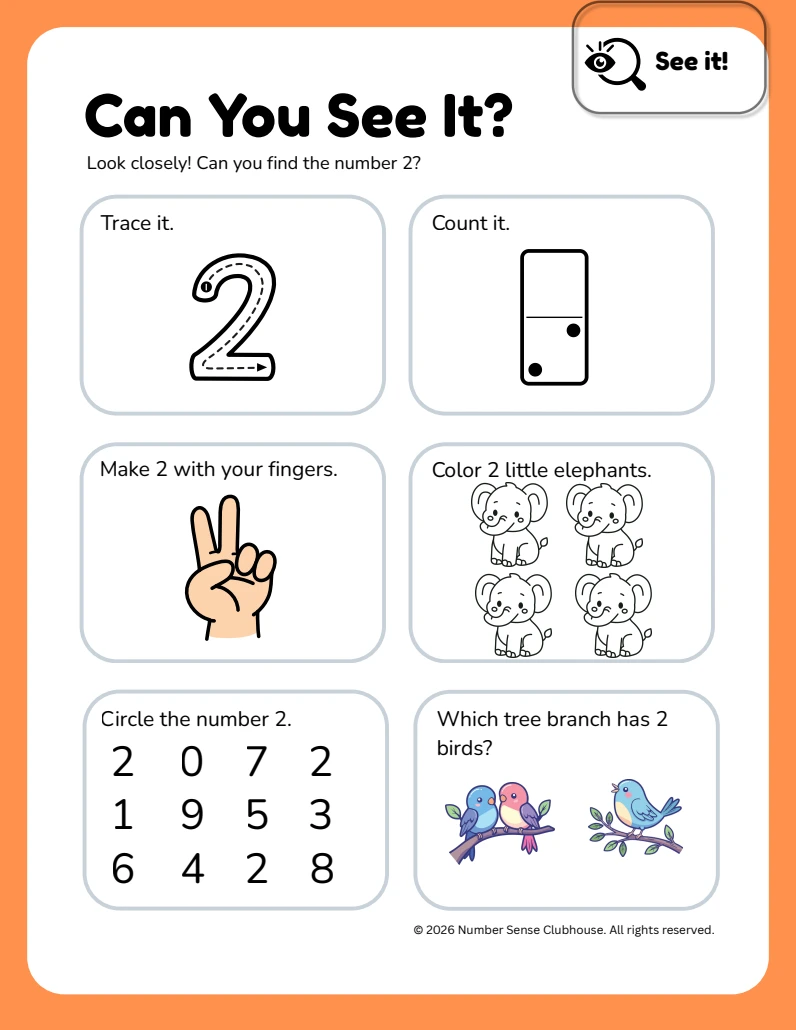
For ready-to-use activities, the Numbers 1–10 Activity Bundle gives each Number Friend a set of pages to meet, see, show, and build their number, including quantities and dot patterns to notice. To start for free, try our Number Friends coloring pages for numbers 1–5. For a festive twist, see our Christmas counting activities for preschoolers, including a jingle bell quick-look game.
Questions about this activity
What is subitizing in simple terms?
Subitizing is knowing how many objects are in a small group just by looking, without counting each one. When you glance at a die and instantly know it shows four, you are subitizing.
At what age do children learn to subitize?
Many children begin recognizing very small groups, like one or two objects, as toddlers. During the preschool years, ages 3 to 5, children often grow to recognize groups up to four or five, especially in familiar patterns like dice dots. Every child develops at their own pace.
What is the difference between perceptual and conceptual subitizing?
Perceptual subitizing is seeing a small amount instantly, like recognizing three dots at a glance. Conceptual subitizing is seeing smaller groups inside a larger one and combining them, like seeing four dots and four dots and knowing there are eight. Conceptual subitizing builds toward addition.
Is subitizing the same as counting?
No. Counting means saying one number word for each object. Subitizing means recognizing the amount all at once. Both are important parts of number sense, and they support each other.
What materials do I need for subitizing activities?
A pair of dice, a deck of playing cards, paper plates with dots, small objects like buttons or blocks, and your fingers are all you need. A simple ten frame drawn on paper is also helpful.
Related guides

Number Sense for Preschoolers: A Parent's Guide
What number sense means for ages 3–6, the five building blocks to look for, and simple everyday ways to explore numbers with your preschooler at home.

Christmas Counting Activities for Preschoolers (Ages 3–6)
10 easy Christmas counting activities and holiday math games for preschoolers, using ornaments, cookies, and wrapping paper you already have at home.