
Ten Frames for Preschoolers: How to Use Them at Home
By Alyssa · Published
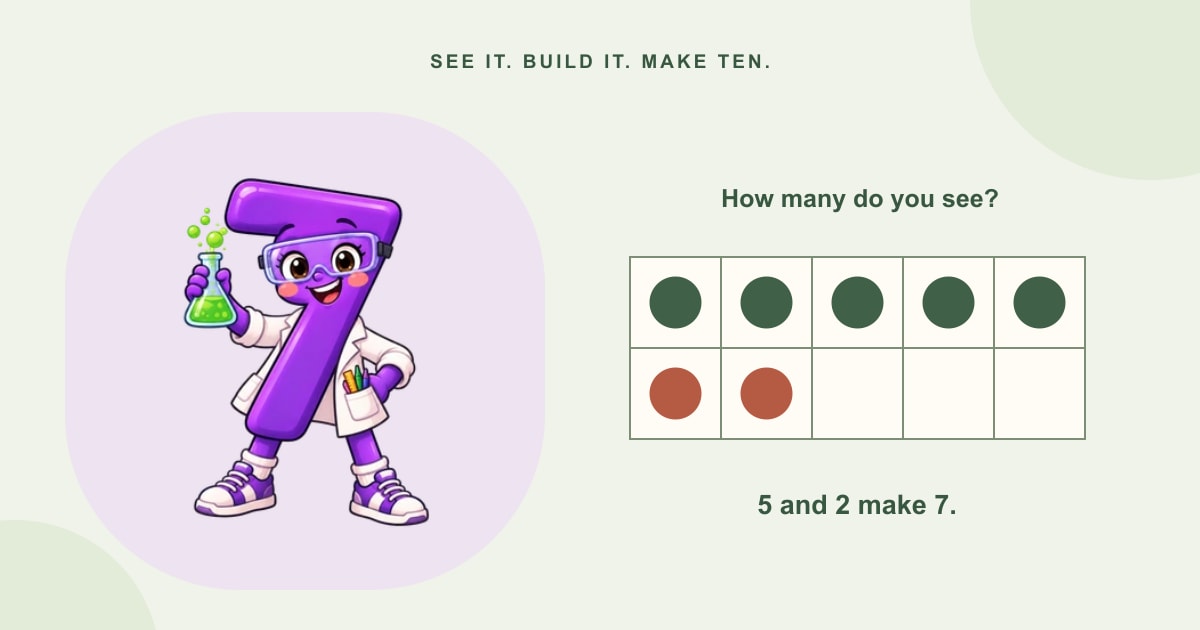
If you have peeked into a preschool or kindergarten classroom lately, you have probably seen a ten frame: a simple grid of ten boxes, often filled with colorful counters. It looks almost too simple to matter. But this little tool is one of the most effective ways to help young children understand numbers.
The best part? You can make a ten frame at home in about a minute with paper and a pencil or an empty egg carton.
This guide explains what a ten frame is, why it helps preschoolers build number sense, and 8 easy ten frame activities you can play at home with children ages 3–6.
What is a ten frame?
A ten frame is a rectangle divided into two rows of five boxes, making ten spaces in all. Children place one counter in each box to show a number from 0 to 10.
Here is what the number 7 looks like on a ten frame:
| ● | ● | ● | ● | ● |
|---|---|---|---|---|
| ● | ● | ○ | ○ | ○ |
Seven is a full row of five, plus two more. And there are three empty spaces, so seven needs three more to make ten. One quick look shows all of that.
Five frames: a gentle place to start
A five frame is a single row of five boxes. It is a great starting point for younger preschoolers who are still exploring numbers from 0 to 5. When your child is comfortable with the five frame, add a second row.
Why ten frames are so helpful for young children
Ten frames help children see numbers instead of only saying them. Here is what they build:
- Counting with meaning. One counter per box encourages one-to-one counting, where each object gets exactly one number word.
- Seeing numbers without counting. Children quickly learn that a full row is 5, so they can recognize 6, 7, or 8 at a glance. This is called subitizing, and our guide What Is Subitizing? explains it in more detail.
- Understanding 5 and 10 as landmarks. Our number system is built around tens. Ten frames make 5 and 10 easy to see and remember.
- Making ten. The empty boxes show how many more are needed to reach ten, which is the foundation for addition facts like 7 + 3 and 6 + 4.
- Early addition and subtraction. Adding a counter shows “one more.” Removing one shows “one less.”
Each of these is a building block of number sense. For the full picture, see our parent's guide to number sense for preschoolers.
How to make a ten frame at home
You do not need to buy anything. Try one of these:
- Paper ten frame: Draw a rectangle and divide it into two rows of five boxes. Make the boxes big enough for your counters.
- Egg carton ten frame: Cut a 12-cup egg carton down to two rows of five.
- Muffin tin: Use 10 cups of a muffin tin, or cover two cups if your tin has 12.
- Tape on the floor: Use painter's tape to make a giant ten frame. Children can jump into the boxes or fill them with stuffed animals.
Counters can be anything small: buttons, coins, pom-poms, dried beans, blocks, or snacks like cereal pieces. Choose items that are safe for your child's age, and supervise closely around small objects.
8 ten frame activities and games for preschoolers
Start with small numbers (0 to 5) and a five frame for younger children. Move toward the full ten frame as your child grows more confident.
1. Build a number
Say a number, and ask your child to build it on the ten frame. Then ask, “How do you know that is six? How many empty spaces are there?”
Skills: one-to-one counting, number recognition
2. Quick-look flash
Fill a ten frame with some counters, show it for two or three seconds, then cover it. Ask, “How many did you see? How did you know?” You might hear, “It was a full row and one more, so six!”
Skills: subitizing, seeing 5 as a landmark
3. Roll and fill
Take turns rolling a die and adding that many counters to the ten frame. The first player to fill all ten boxes wins. Ask along the way, “How many more do you need to fill it?”
Skills: counting on, making ten, turn-taking
4. How many more to make ten?
Place some counters on the ten frame and ask, “How many more do we need to make ten?” Let your child count the empty spaces, then fill them to check.
Skills: making ten, number pairs, early addition
5. Two-color ten frame
Use two colors of counters. Fill the frame with, say, 4 red and 6 yellow. Ask, “How many red? How many yellow? How many altogether?” Then find other color combinations that make ten.
Skills: composing and decomposing numbers, addition facts to ten
6. One more, one less
Build a number, like 5. Ask your child to show “one more” by adding a counter, then “one less” by removing one. Talk about what changed each time.
Skills: early addition and subtraction, number relationships
7. Ten frame story problems
Tell a short story while your child acts it out with counters: “Four ducks were swimming in the pond. Two more ducks joined them. How many ducks are in the pond now?” Then try a take-away story.
Skills: problem solving, addition and subtraction, explaining thinking
8. Giant floor ten frame
Make a big ten frame on the floor with painter's tape. Call out a number, and your child places that many stuffed animals, toy cars, or shoes in the boxes, or jumps from box to box while counting.
Skills: counting, movement, number recognition
Questions to ask during ten frame play
Good questions turn a ten frame into a conversation about numbers. Try:
- How many counters are there? How do you know?
- How many empty spaces are there?
- How many more do we need to make ten?
- Is it more than five or less than five?
- Can you show this number a different way?
- What would happen if we added one more?
Listen to your child's thinking. Answers like “It's five and two” show your child is starting to see numbers in groups.
Tips for using ten frames at home
Start with a five frame. For younger preschoolers, one row of five is plenty.
Fill the top row first. Filling the top row left to right, then the bottom row, makes numbers easier to recognize. Exploring other arrangements is also fine and can lead to great conversations.
Keep it hands-on. Real counters help children connect numbers to amounts.
Keep it short. Five to ten minutes is plenty for a preschooler.
Revisit often. Ten frames become more powerful the more your child sees them.
Ten frames in seasonal play
Ten frames are easy to theme for holidays. Use jingle bells and an egg carton for a Christmas ten frame, or try any of the ideas in our Christmas counting activities for preschoolers.
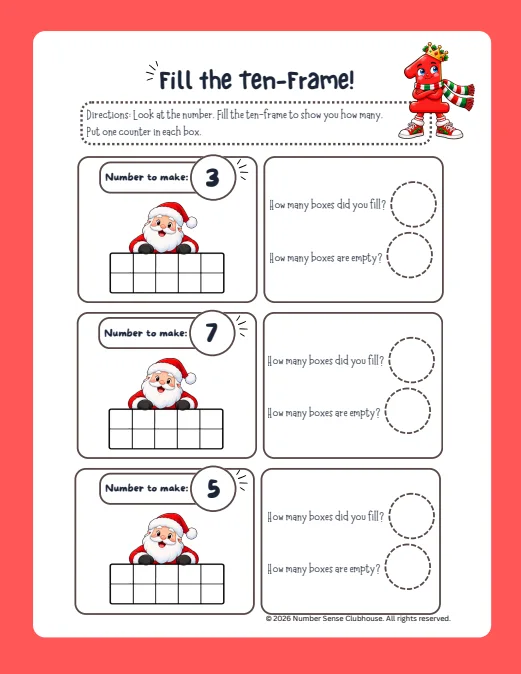
Our Christmas Mission Activity Bundle includes ten frame activities like Fill the Ten Frame and the Christmas Cheer Barometer, where children help Number Friends 7 and 3 make ten.
Get started with ten frames this week
Draw a ten frame on paper, grab a handful of buttons or cereal, and try one game from this list. A few minutes of play, repeated over the week, can help your child see numbers in a whole new way.
For more ways to explore numbers 0–10, the Numbers 1–10 Activity Bundle invites children to show each number with drawings, fingers, numerals, objects, and ten frames. To meet the Number Friends for free, try our number coloring pages for numbers 1–5.
Questions about this activity
What is a ten frame?
A ten frame is a rectangle divided into two rows of five boxes, making ten spaces in all. Children place counters in the boxes to show numbers from 0 to 10. It helps them see how a number relates to 5 and 10.
What age should children start using ten frames?
Many children are ready to explore ten frames around ages 3 to 4, starting with small numbers and a five frame (one row of five). By kindergarten, children often use a full ten frame to explore making ten and early addition. Follow your child's readiness rather than a strict age.
How do you fill a ten frame?
The common convention is to fill the top row from left to right first, then the bottom row from left to right. This makes it easy to see numbers like 5 (a full top row) and 7 (a full top row plus 2). Young children can explore other ways too, and talking about different arrangements is valuable.
Can I make a ten frame at home?
Yes. Draw two rows of five boxes on paper, or cut an egg carton down to ten cups. Use buttons, coins, pom-poms, dried beans, or small snacks as counters. Choose objects that are safe and age-appropriate for your child.
What is the difference between a five frame and a ten frame?
A five frame is a single row of five boxes, and a ten frame has two rows of five. Five frames are a gentle starting point for younger preschoolers working with numbers 0 to 5. Ten frames extend that to numbers up to 10.
Related guides

What Is Subitizing? 8 Games for Preschoolers (Ages 3–6)
What subitizing is, why it matters for early math, and 8 easy subitizing games to play with your preschooler using dice, dots, and fingers.
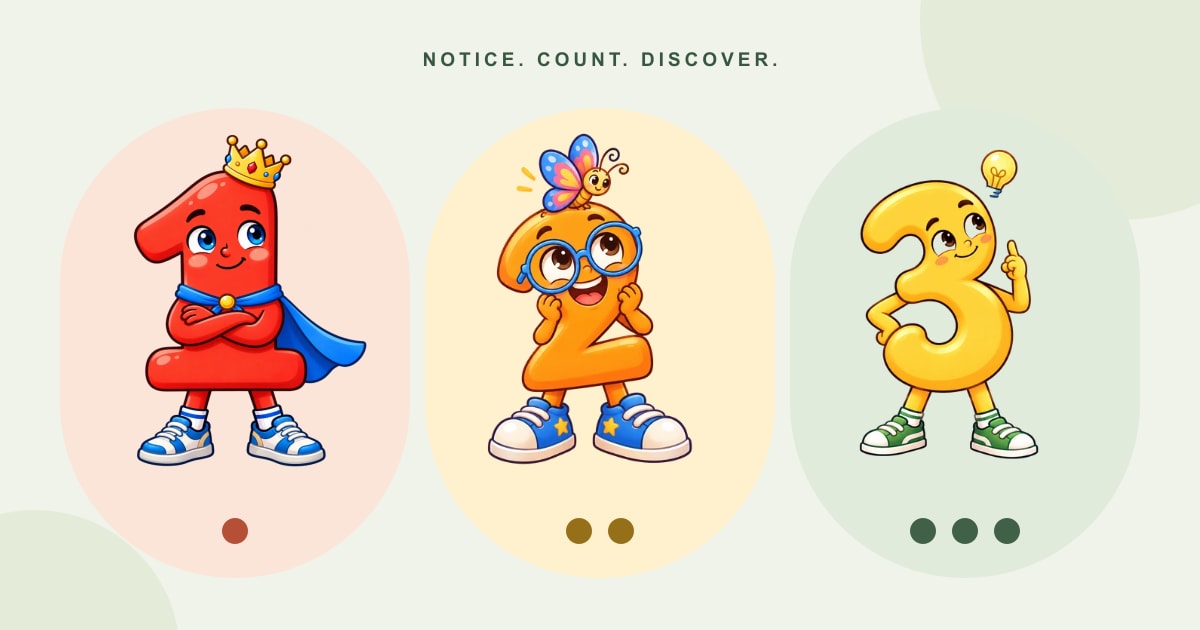
Number Sense for Preschoolers: A Parent's Guide
What number sense means for ages 3–6, the five building blocks to look for, and simple everyday ways to explore numbers with your preschooler at home.
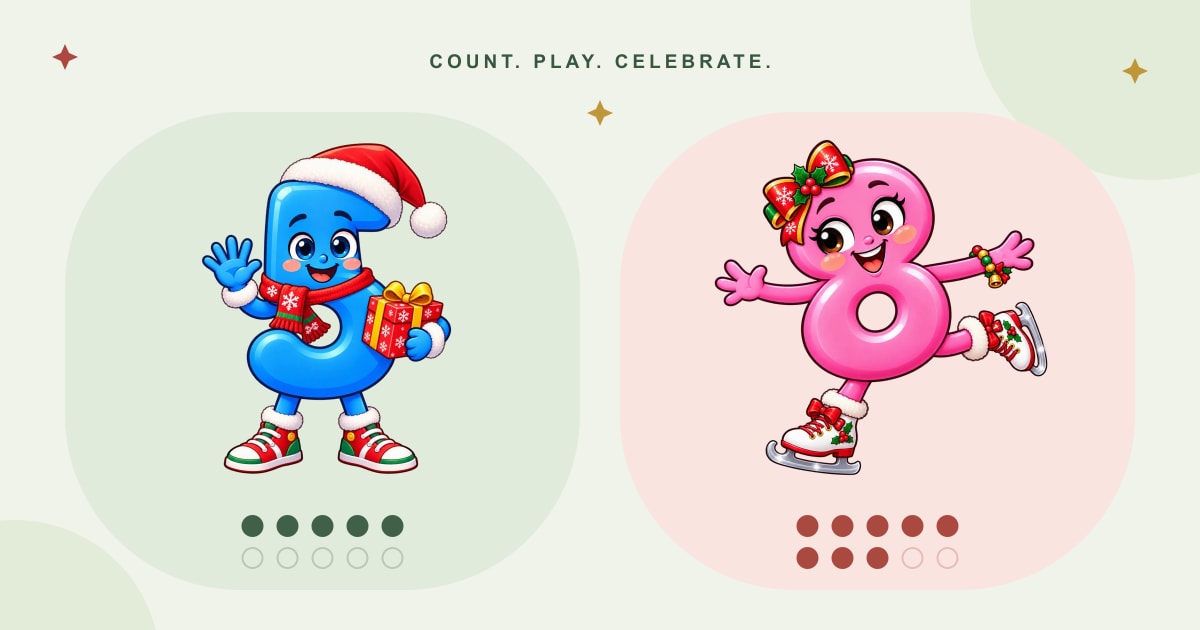
Christmas Counting Activities for Preschoolers (Ages 3–6)
10 easy Christmas counting activities and holiday math games for preschoolers, using ornaments, cookies, and wrapping paper you already have at home.