
What Are Number Bonds? Simple Games for Making 5 and 10
By Alyssa King · Published
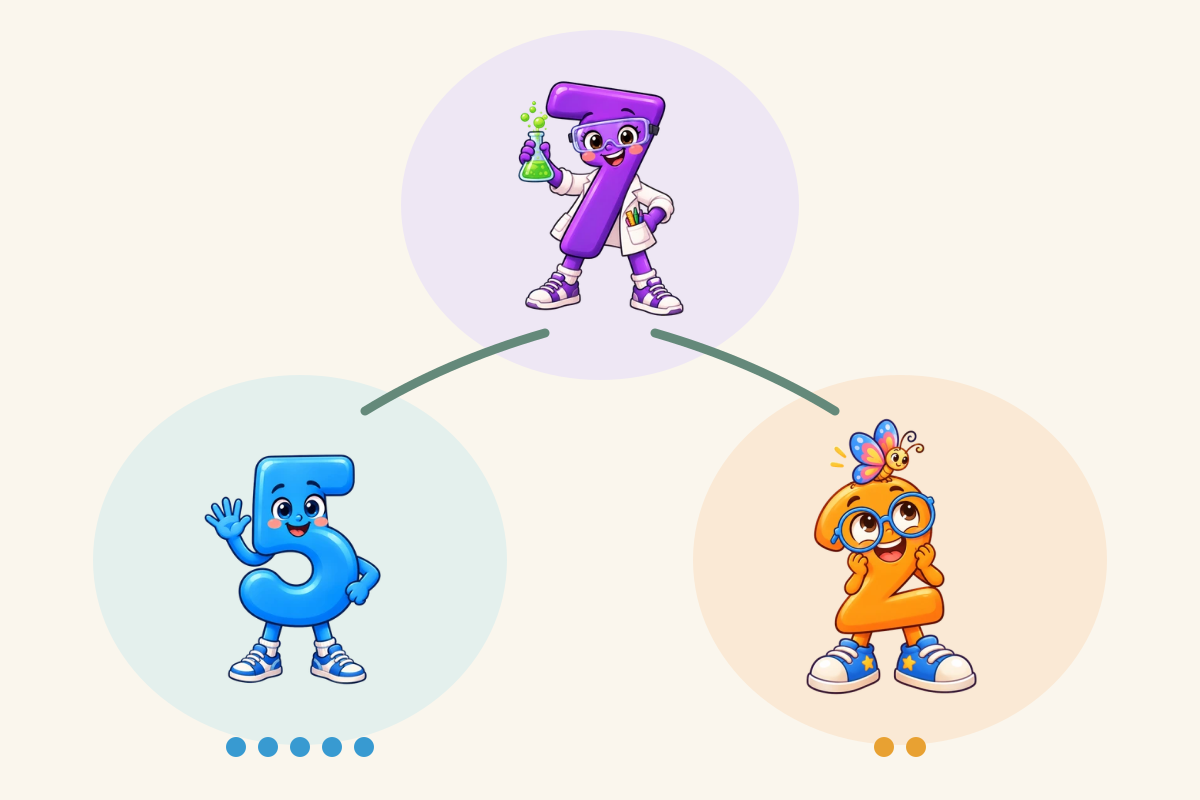
Number bonds show how a whole number can be split into parts. For example, 5 can be made from 2 and 3, or from 4 and 1. Children can explore those relationships by moving real objects before working with written equations.
If your child brings home a page of connected circles, that is usually what the diagram is showing: a whole and its parts. You do not need to recreate a math lesson at the kitchen table. Start with a few toys and a question: “How else could we split these up?”
How do you read a number bond?
A common number bond has three connected circles. One holds the whole. The other two hold the parts.
For a bond showing 5 as 2 and 3: Whole: 5 One part: 2 Other part: 3
The parts together equal the whole. You are not adding all three circles, so this diagram does not mean 5 + 2 + 3. It shows one collection of five objects, separated into two groups.
The whole circle might be above the parts or beside them. Look at the connections rather than assuming the largest number always goes at the top. With whole numbers, a part cannot be larger than the whole, but it can be equal to it when the other part is zero.
Try drawing a bond after your child has divided five blocks into two groups. The picture then records something they have already done.
Why do children learn number bonds?
Counting tells a child how many objects there are. Number bonds help them explore what is inside that amount: six can be five and one, or three and three.
This work is often called composing and decomposing numbers. NAEYC describes it as exploring the structure of a number, with concrete objects giving children a way to see and discuss the relationships. Read NAEYC’s guide to number composition.
The Common Core kindergarten math standards include splitting numbers up to 10 into pairs in more than one way, and finding the number that joins another to make 10. Those are kindergarten learning goals, not a checklist your preschooler must finish before starting school. See the kindergarten operations standards.
Where should you start?
Choose an amount your child can comfortably count. That may be three objects rather than ten. NAEYC recommends beginning with smaller numbers and using concrete materials; children do not all develop the supporting counting skills at the same rate.
If your child is still learning to count each object once, start with our guide to teaching preschoolers to count. You can still play with groups together, but there is no need to ask for missing numbers yet.
For the activities below, use large blocks or toys your child already plays with safely. Avoid small loose pieces if your child puts objects in their mouth. An adult should cut out any cards and supervise play.
Four number bond activities to try at home
1. Park four cars in two garages
Fold two pieces of paper into simple parking spaces, or use two open boxes. Count four toy cars together. Invite your child to park them however they like.
Perhaps one garage gets three cars and the other gets one. Say, “Three here and one here. We still have four cars.”
Ask your child to move one car to the other garage. Now what do they notice? Let them move cars back and forth without bringing any new ones into the game.
If every car ends up in one garage, keep that arrangement. Four and zero is another way to make four. An empty garage gives zero a useful job.
2. Find another way to show five
Show five raised fingers across both hands: two on one hand and three on the other. Ask your child whether they can show five a different way.
They might hold up four fingers and one, or all five on a single hand. Count the raised fingers together when needed.
Keep your language tied to what they can see: “You changed your hands, but you’re still showing five.” If they show six by accident, count together and let them decide what to change. The goal is to explore the amount, not copy your hand position.
3. Hide part of a small collection
Count four large blocks together. While your child looks away, cover some with a cloth. Leave the others visible. Ask, “We started with four. Two are showing. How many do you think are under here?”
Let your child lift the cloth to check. They can count everything again. Switch roles so they get to hide the blocks too.
This is adapted from Stanford DREME’s Hidden Objects game, which uses a known total and a visible part to explore the missing part. Start with fewer objects if guessing takes over. Keep the game untimed and talk about how you know.
4. Find the card that makes ten
Try this after your child is comfortable exploring smaller totals. Draw two rows of five boxes to make a ten frame, then place one large block in each of seven boxes. Ask, “How many spaces are still empty?”
Your child can count the three empty boxes, then fill them to check. Put a 7 card beside the first group and a 3 card beside the second. Together, they fill all ten spaces.
Use our free number playing cards, or write your own. Begin with just a few choices face up rather than asking your child to search the whole deck. Print two sets if you want to show 5 and 5 with two cards.
For help drawing and using the grid, see our ten frame guide. If ten feels like too much, draw one row of five and play the same game with a smaller total.
Number bonds to 5 and 10: a quick parent reference
These examples are for you to refer to during play, not a list your child needs to recite.
Ways to make 5: 0 and 5 • 1 and 4 • 2 and 3 • 3 and 2 • 4 and 1 • 5 and 0
Ways to make 10: 0 and 10 • 1 and 9 • 2 and 8 • 3 and 7 • 4 and 6 • 5 and 5 6 and 4 • 7 and 3 • 8 and 2 • 9 and 1 • 10 and 0
Reversing the parts does not change the total. Three cars in the left garage and one in the right is still four cars when you swap the groups.
What if my child counts everything again?
Let them check. You can say, “You counted them to make sure. There are still five.” Then move one object between the groups and wonder aloud whether the total has changed.
Watch what your child does rather than pushing for an instant answer. Can they make two groups? Can they explain what moved? Those observations tell you more than how quickly they name a missing number.
If the game becomes frustrating, leave the objects visible or use a smaller collection. You can come back to hidden parts another day.
Try one game with the free number cards
Color the Number Friends together, then have a grown-up cut out the cards. Choose a target such as five and look for a pair that makes it. Keep blocks nearby so your child can build each amount and check.
Download the free 0–10 number playing cards. The printable is delivered by email, with no purchase needed. You can also use handwritten cards; the important part is the conversation you have while playing.
Sources and further reading
NAEYC: Playing Around with Number Composition: Games, Stories, and Everyday Problem Solving in the Preschool Classroom. Common Core State Standards: Kindergarten, Operations & Algebraic Thinking, particularly K.OA.A.3–4. Stanford DREME: Hidden Objects. Source for the adapted hiding game.
Related guides
How to Teach Preschoolers to Count: A Step-by-Step Guide
How to teach preschoolers to count with meaning: 6 simple steps, playful counting games, and fixes for skipped numbers and other common counting mix-ups.
Ten Frames for Preschoolers: How to Use Them at Home
What a ten frame is, why teachers love it, and 8 easy ten frame activities and games to build counting and number sense with your preschooler at home.
How to Teach Number Recognition to Preschoolers
Help your preschooler recognize numbers 0–10 with six playful activities. Connect written numbers to quantities using simple games and free printables.