Pattern Activities for Preschoolers: 6 Easy Games at Home
By Alyssa King · Published
A row of toys can become a math game before anyone reaches for a worksheet. Put down a toy car, then a block. Add another car and another block. Pause. What would your child put next?
To teach patterns to preschoolers, start with a short sequence that repeats, say it aloud together, and invite your child to continue it. An AB pattern alternates two things, such as car, block, car, block. The goal is to notice the rule, not guess the adult’s answer.
Try this AB pattern: clap, tap, clap, tap
Clap, tap, clap, tap. Pause and let your child do what comes next. Then build the same pattern with a toy car and a block.
What is an AB pattern?
An AB pattern repeats two different elements in the same order. “A” stands for one element and “B” for the other. They might be colors, objects or movements. Your child does not need to read the letters to play.
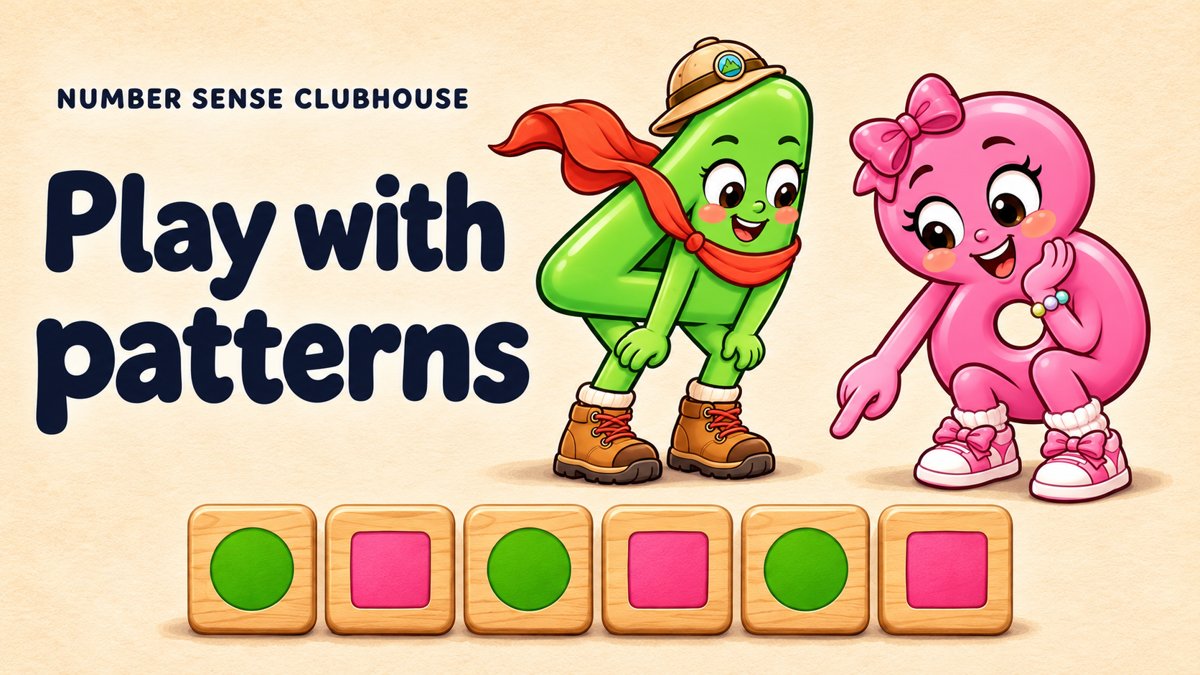
For example, green, pink, green, pink follows an AB rule. Green, pink, pink, green, pink, pink follows an ABB rule. In each case, a small group repeats. This group is called the repeating unit.
Start with the objects’ names rather than a vocabulary lesson. “Car, block” is enough. Early-years guidance from NCETM emphasizes helping children notice the repeating unit, not only the next item. [1]
Why are patterns part of preschool math?
Patterns give children something to explain: “I put a block here because a block comes after every car.” That is different from choosing whichever toy looks fun.
Education Development Center researchers describe pattern play as practice in looking for mathematical structure. Children notice a rule and use it to make sense of what follows. [2] You do not need to turn that into a lesson about algebra. For now, finding a rule in a row of toys is plenty.
Before you start
Pick one game, not all six. Use materials your child can easily handle, with an adult nearby. Large blocks, paper shapes and socks work well. Skip small loose pieces if your child still mouths objects.
For a first attempt, keep the difference obvious. Two colors of otherwise similar blocks are easier to discuss than a mix of objects that differ in every way. Leave enough room to move the pieces. If your child wants to build something else, the pattern can wait.
6 easy pattern activities for preschoolers
1. Make a road for Number 4
Lay out six large paper squares in a row: green, pink, green, pink, green, pink. Tell your child Number 4 needs a longer path. Offer a green square and a pink square, then ask which one belongs next.
Read the path together before adding anything. Once it is extended, slide two squares slightly away from the row to show the little group that keeps returning. Ask, “Can we make another green-pink part?”
The story is optional. A toy vehicle can travel along the path, or your child can point along it. Keep the focus on the repeating order rather than naming colors perfectly.
2. Play a movement echo
Choose two comfortable movements, such as touching your head and tapping your knees. Do head, knees, head, knees, then let your child join in. Slow down so you can stay together.
Take turns being the leader. Your child might choose waving and clapping instead. Seated movements work just as well. New York’s Early Learning Guidelines include movement and sound patterns as ways to explore patterning, so this does not have to be a table activity. [3]
3. Give Number 8 a sock parade
Collect several plain socks and several striped socks. Lay them flat in a plain-striped pattern, with each pair of types repeated. Explain that Number 8 is organizing a very unusual parade.
Ask your child to add the next two socks. Then let them rearrange the parade and tell you the new rule. If they make plain, plain, striped over and over, that is a pattern too. It does not have to alternate one of each.
No suitable socks? Draw two kinds of shoes on paper and use those. You are looking for a repeated arrangement, not a perfectly coordinated laundry basket.
4. Read a pattern in a picture book
Try a library copy of Pattern Bugs by Trudy Harris. NAEYC’s guide to pattern books highlights its repeating language and visual patterns. [4] Read a few pages together, then pause where your child might notice what repeats.
You can also explore an illustrated book you already own. Look closely at a scarf or a border. Ask, “Does a part repeat here?” A colorful picture is not automatically a repeating pattern. If there is no clear rule, simply turn the page.
5. Leave a space in a paper chain
Cut large paper rectangles in two colors. Before gluing anything, arrange them on the table as yellow, blue, yellow, blue, yellow, blue. Remove one from the middle and leave a visible gap.
Ask your child to fill the space, then check the entire row together. Once they like the arrangement, an adult can help turn it into a paper chain. Leaving the pieces loose first means your child can change their mind without having to tear the craft apart.
6. Make a new version of the same rule
This is a next step for a child who comfortably continues simple patterns. Make a row of alternating toy cars and blocks. Beside it, place alternating paper circles and squares.
Ask, “These use different things. Is anything the same about them?” You can point out how each row keeps switching between two choices. Then invite your child to invent a sound version.
NCETM describes recreating a pattern with different materials as a way to explore its structure. [1] If this feels confusing, go back to playing with the original row. There is no need to rush into the harder version.
What if my child does not get patterns yet?
Make the task smaller. Build the pattern together and talk through your own choice: “I just put down a car. A block comes next in my pattern.” Let your child copy you before asking them to make a rule of their own.
Continuing a pattern and explaining its repeating unit are not the same task. A 2026 study of children ages 4–7 found that completing patterns was easier than explicitly identifying the repeating unit. [5] A child may make a good choice before they can explain why.
Avoid using one game as a readiness test. New York’s guidelines explicitly recommend flexible age bands and note that their examples are not standards. [3] Choose the version your child enjoys working on with you.
Bring the Number Friends into play
For a character-led version, use our free Number Friends coloring pages. Print extra copies of two favorite characters, color them, and arrange them into a repeating parade. Tell your child you are repeating the characters, not counting forward. [6]
If your child wants a number game afterward, try matching one character to a collection of that many objects. Our number-recognition guide explains how to connect a written number to an amount. [7]
For today, one short pattern is a good place to stop. Let your child make the last rule and see whether you can follow it.
Sources and further reading
Related guides
What Math Should Kids Know Before Kindergarten? A Checklist
A parent-friendly kindergarten math readiness checklist for ages 3–5: counting, numbers, shapes, and patterns, based on Head Start and Common Core guidance.
How to Teach Number Recognition to Preschoolers
Help your preschooler recognize numbers 0–10 with six playful activities. Connect written numbers to quantities using simple games and free printables.
Math Talk for Preschoolers: Easy Ways to Talk About Numbers
What research says about math talk at home, plus simple everyday phrases, counting book tips, and number questions that build your preschooler's math skills.