What Math Should Kids Know Before Kindergarten? A Checklist
By Alyssa King · Published
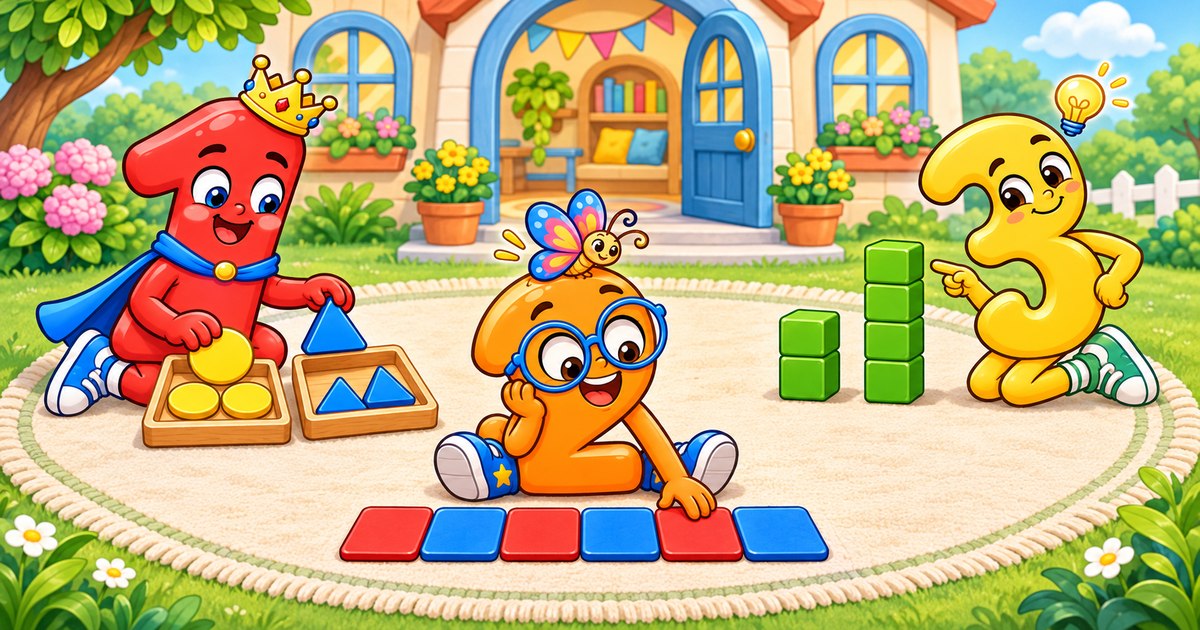
Before kindergarten, useful math experiences include counting real objects, explaining how many there are, comparing groups, and exploring shapes and patterns. The Head Start preschool framework describes how these skills develop. Common Core kindergarten standards describe learning goals for the school year; ask your school about its own entry expectations.[4][3]
As a former math teacher and a mom, I know the pressure parents feel as kindergarten gets close. This guide gives you a clear, research-informed kindergarten math readiness checklist for children ages 3 to 5, plus simple ways to practice each skill at home.
Key takeaways
- Understanding beats memorizing. Counting 10 objects correctly is more useful than reciting numbers to 50.
- Separate school-year goals from entry expectations. Common Core places counting to 100 in kindergarten; your school can explain what it expects when children arrive.
- Preschool math has four main areas: counting and cardinality, early operations, measurement, and geometry and spatial sense, according to the Head Start Early Learning Outcomes Framework.
- Early math matters. In a large analysis, math skills at school entry were the strongest predictor of later achievement among the skills measured.[1]
- Everyday play works. Counting snacks, comparing piles, and board games build these skills naturally.
Why kindergarten math readiness matters
Early math skills are linked to later school success. Researchers led by Greg Duncan analyzed six long-term studies and found that children's math skills when they entered school were the strongest predictor of later achievement among the school-entry skills they measured, including later reading achievement.[1] This is a connection, not proof of cause and effect. Still, it is one reason early childhood educators encourage families to make math part of everyday life.
The National Association for the Education of Young Children (NAEYC) and the National Council of Teachers of Mathematics (NCTM) agree. Their joint position statement says high-quality, accessible math experiences for 3- to 6-year-olds are a vital foundation for future math learning.[2]
What does kindergarten math actually cover?
Knowing what kindergarten teaches helps you see what to build before it starts. In the Common Core State Standards, which many states use or adapt, kindergarten math includes goals such as:[3]
- counting to 100 by ones and by tens
- writing numbers from 0 to 20
- counting to answer "how many?" for up to 20 objects arranged in a line, array, or circle, or up to 10 scattered objects
- comparing two numbers between 1 and 10
- adding and subtracting within 10 using objects or drawings
- finding the number that makes 10 when added to a number from 1 to 9
These standards describe learning during kindergarten. Schools may have different entry expectations, and standards vary by state. Check your state’s standards or ask your school.
Kindergarten math readiness checklist (ages 3–5)
This checklist follows the four preschool math areas in the Head Start Early Learning Outcomes Framework.[4] Children develop at different paces. Use it to spot what to play with next, not as a test.
Counting and cardinality
Cardinality means understanding that the last number you count tells how many are in the group.[4]
- Says the number words in order, at least to 10
- Counts objects by touching or pointing to each one once (one-to-one correspondence)
- Answers "How many?" with the last number counted, without recounting
- Counts out a requested amount ("Bring me 4 spoons")
- Recognizes small groups of one to four objects without counting (subitizing)
- Recognizes some written numerals, such as 1 to 5 or 1 to 10
Comparing and early operations
- Tells which of two groups has more, fewer, or the same
- Understands that adding one more makes a group bigger, and taking one away makes it smaller
- Solves simple put-together and take-away stories with objects or fingers ("2 ducks and 1 more duck")
- Notices that a number can be split into parts (5 is 3 and 2)
Measurement
- Uses size words: bigger, smaller, longer, shorter, taller, heavier
- Compares two objects by length or height
- Sorts objects by color, size, or type, and explains the rule
Geometry and spatial sense
- Names common shapes: circle, square, triangle, rectangle
- Describes position with words like above, below, next to, inside, and behind
- Builds and takes apart shapes with blocks or puzzles
Patterns
- Notices and continues simple patterns (red, blue, red, blue)
- Creates their own pattern with objects, sounds, or movements
What math should a 3-year-old know?
Three-year-olds are often just beginning. Many are learning to say number words in order, count very small groups, and notice "more." Focus on counting real objects up to 3 to 5, naming "how many," and playing with shapes and sizes. Our guide to number sense for preschoolers explains these early building blocks.
What math should a 4-year-old know?
Many 4-year-olds can count a small group of objects accurately, recognize small amounts at a glance, compare groups, and name basic shapes. This is a great age to strengthen counting with meaning up to 10, practice "one more" and "one less," and play simple number games. See how to teach preschoolers to count for step-by-step help.
What math should a 5-year-old know before kindergarten?
Many children entering kindergarten can count objects up to about 10, answer "how many?" confidently, recognize some numerals, compare groups, and describe shapes and positions. Some are ready to explore making 10 and simple addition stories, which kindergarten will build on.
7 easy ways to build kindergarten math skills at home
- Count real things every day: stairs, snacks, toys at clean-up. Finish with "How many?"
- Compare at snack time: "Who has more crackers? How do you know?"
- Play board and dice games. Moving along a numbered path builds counting and number sense. See math board games for preschoolers for the research.
- Use a ten frame: two rows of five boxes help children see numbers to 10. Learn how in ten frames for preschoolers.
- Play "quick look" with dot cards or dice to build subitizing. Try the games in What Is Subitizing?.
- Talk about math during routines. Size, shape, and number words all count. Our guide to math talk for preschoolers shares research-backed phrases.
- Hunt for shapes and patterns on walks, in books, and around the house.
Signs your child might want extra support
Every child develops at their own pace, and skills often come in bursts. If counting small groups or comparing amounts remains difficult as kindergarten approaches, share specific observations with your child’s teacher and ask what support would be useful. If you have concerns about your child's overall development, talk with your child's preschool teacher or pediatrician.
Get kindergarten-ready with the Number Friends
Strong number sense is the heart of kindergarten math readiness. The Numbers 1–10 Activity Bundle helps children meet, see, show, and build each number from 0 to 10 through coloring, counting, tracing, and hands-on play. To start for free, try our Number Friends coloring pages for numbers 1–5.
Research and further reading
- Duncan, G. J., Dowsett, C. J., Claessens, A., et al. (2007). School readiness and later achievement. Developmental Psychology, 43(6), 1428–1446. An analysis of six longitudinal datasets; the associations do not establish cause and effect.
- National Association for the Education of Young Children & National Council of Teachers of Mathematics (2002, updated 2010). Early childhood mathematics: Promoting good beginnings. Joint position statement. Professional guidance for high-quality mathematics experiences for ages 3–6.
- National Governors Association Center for Best Practices & Council of Chief State School Officers (2010). Common Core State Standards for Mathematics: Kindergarten. Counting & Cardinality; Operations & Algebraic Thinking. School-year learning standards; check local school expectations separately.
- Office of Head Start (2015). Math Preschool: Mathematics Development. Head Start Early Learning Outcomes Framework: Ages Birth to Five. Describes preschool developmental progressions in counting, cardinality, and other math skills.
Common questions
What math should a child know before starting kindergarten?
Helpful starting experiences include counting objects up to about 10, knowing that the last number counted tells how many, comparing which group has more, recognizing some numerals and basic shapes, and noticing simple patterns. Kindergarten builds on these skills throughout the year. Ask your school about its entry expectations.
Does my child need to count to 100 before kindergarten?
No. In the Common Core State Standards, counting to 100 by ones and by tens is a goal for the end of kindergarten, not a requirement for starting it. Before kindergarten, counting objects with understanding up to about 10 is a more useful focus than reciting long number lists.
What math does a 4-year-old usually know?
Many 4-year-olds can count a small group of objects, recognize groups of one to three or four at a glance, compare which of two groups has more, and name some shapes. Children develop at different paces, so treat these as examples, not a test. Talk with your child's teacher or pediatrician if you have concerns.
What are the main early math skills for preschoolers?
The Head Start Early Learning Outcomes Framework groups preschool math into four areas: Counting and Cardinality; Operations and Algebraic Thinking; Measurement; and Geometry and Spatial Sense. In everyday terms, that means counting with meaning, early adding and taking away, comparing sizes and amounts, and exploring shapes and positions.
How can I help my child get ready for kindergarten math at home?
Count real objects together, ask “How many?” and “Which has more?”, play simple board and dice games, read counting books, and talk about shapes and sizes during everyday routines. Use short, playful moments in familiar routines and follow your child’s interest.
Related guides
Number Sense for Preschoolers: A Parent's Guide
What number sense means for ages 3–6, the five building blocks to look for, and simple everyday ways to explore numbers with your preschooler at home.
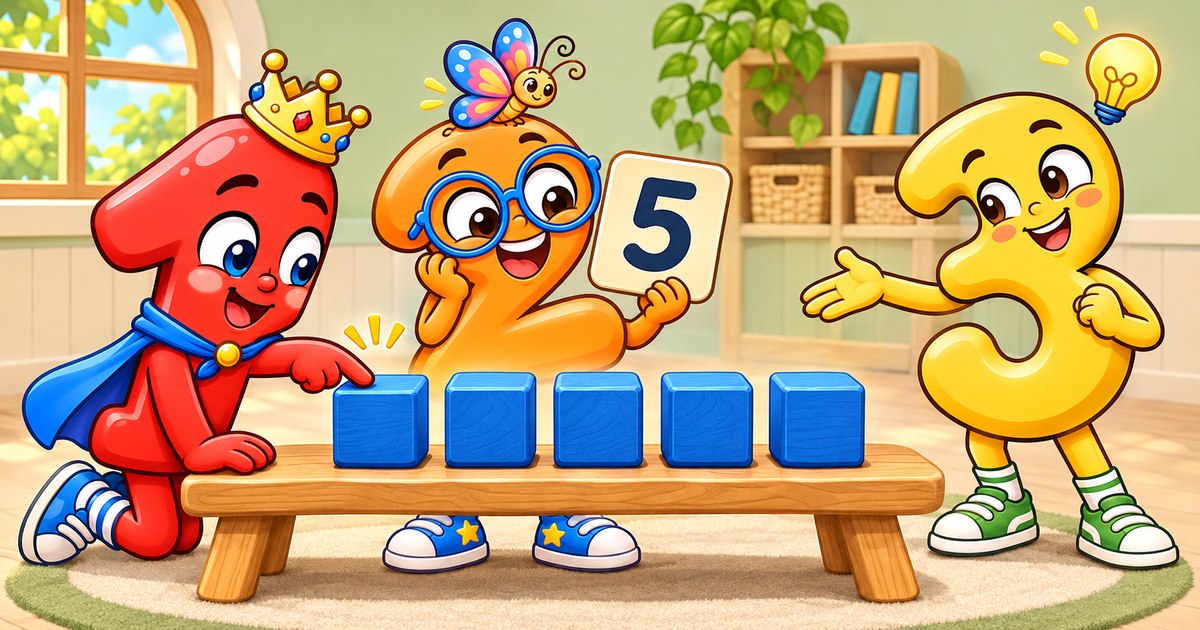
How to Teach Preschoolers to Count: A Step-by-Step Guide
How to teach preschoolers to count with meaning: 6 simple steps, playful counting games, and fixes for skipped numbers and other common counting mix-ups.
Math Talk for Preschoolers: Easy Ways to Talk About Numbers
What research says about math talk at home, plus simple everyday phrases, counting book tips, and number questions that build your preschooler's math skills.